Gross Motor Function Classification System
Gross Motor Function and Cerebral Palsy
Not all cases and symptoms of cerebral palsy are the same. Each child will experience varying levels of impairment to their muscle control, communication abilities, and cognitive functioning.

Some children with cerebral palsy will be able to walk and talk on their own with limited assistance. Others may need to rely on assistive devices and equipment such as wheelchairs, walkers, hearing aids, or augmentative communication devices.
A child’s classification of cerebral palsy and the severity of their symptoms will determine how much assistance they need. Healthcare providers use different tools to assess and predict the level of assistance a child may need throughout their life. The Gross Motor Function Classification System (GMFCS) can provide this insight.
The Gross Motor Function Classification System can help medical professionals and families prepare for the child’s success by outlining their required level of treatment. They can use it as a benchmark to understand how best to assist children with their cerebral palsy symptoms.
Utilizing the Gross Motor Function Classification System can help families provide a higher quality of life for their children by better understanding their needs.
Birth Injury Malpractice Attorneys
Our top rated cerebral palsy attorneys specialize in identifying how medical errors during birth lead to lifelong conditions like cerebral palsy. One common cause of cerebral palsy is brain damage at birth from oxygen deprivation, which is often preventable.
If you or someone you know suffered from the effects of birth injury negligence, don’t hesitate to contact our firm. We can answer difficult legal and medical questions and investigate the facts on your behalf.
Free Legal Consultation
Birth Injury Lawyers
(888) 987-0005Our Birth Injury Lawyers are available to meet you in your home or the hospital.
Our vast network of medical experts and in-house nursing staff and nurse-attorneys gives us the edge over our competition. When we take your case, we assign you with an entire medical team. This team not only consists of attorneys but also nursing advocates and medical experts.
Your team is available to assist with any day-to-day treatment you or your child may need. This includes assistance with medical records, scheduling doctors’ appointments, providing transportation, and any other problems that may arise.
We offer all of this on a contingency fee basis. This means you will not pay any fees until after we win your case and secure a settlement. Miller Weisbrod Olesky’s unmatched track record of birth injury results sets us apart from other birth injury law firms.

Recent Birth Injury Settlement:
Birth Injury settlement against a hospital in which nurses and physicians failed to properly monitor the mother's blood pressure during delivery causing an HIE event resulting in neonatal seizures and cerebral palsy at birth. Our team of top-rated birth injury lawyers recovered $13,750,000 for the family to help with future medical expenses and developmental therapy.
What is a Gross Motor Function Classification System for Children?
The Gross Motor Function Classification System (GMFCS) is a set of guidelines for categorizing a child’s physical capability level. Parents and healthcare providers answer a set of questions about the child’s abilities to see what level matches their skills.
A group of professors from Drexel and McMaster Universities originally created the GMFCS in 1997. It has since undergone multiple revisions and expansions. Specialists in the field most recently updated the system in 2007 to include testing for children ages 12-18.
“Gross Motor Function” refers to using large muscle groups together to perform movements like standing, walking, running, or bending over.
This is different from fine motor function, which involves engaging the smaller muscles for more precise movements. Activities that engage fine motor skills include writing, playing an instrument, or brushing your teeth.
The current Gross Motor Function Classification System can be used to assess children within five different age groups:
- Children ages 0 to 2 years
- Children ages 2 to 4 years
- Children ages 4 to 6 years
- Children ages 6 to 12 years
- Children ages 12 to 18 years (most recent addition)
For each age group, the expectations and criteria for classifying will of course be different. The questions typically align with the expected developmental milestones for the child’s age. They will ask about the child’s physical performance in common settings like at home, at school, or within the community.
What are the Levels of the Gross Motor Function Classification System?
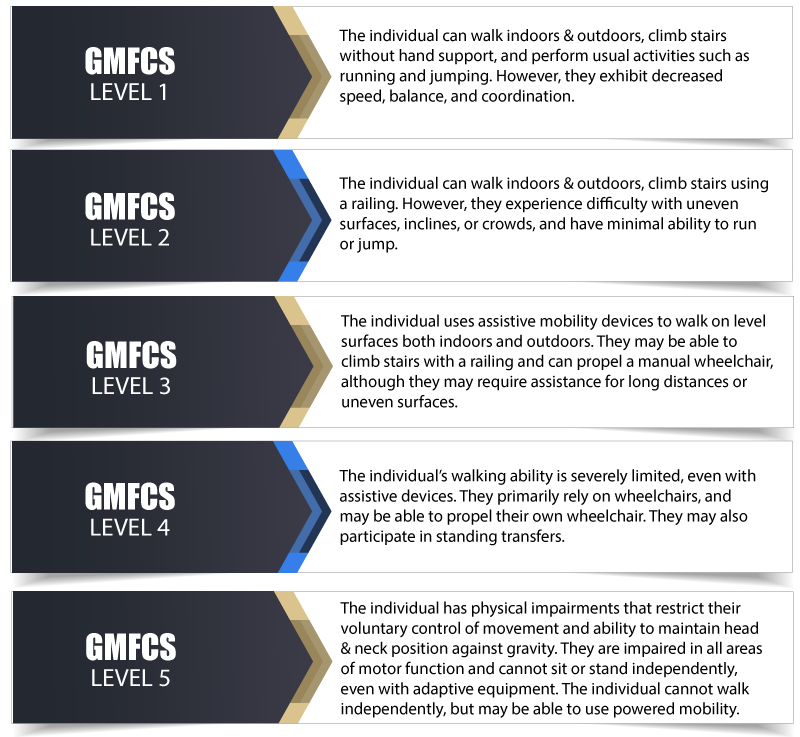
The Gross Motor Function Classification System has five levels that increase in severity. A child at Level I has functional gross motor skills and requires little to no assistance with completing everyday tasks. A child at Level V, on the other hand, has limitations that impair nearly all motor function. Children in the Level V category will rely heavily on assistive devices and equipment.
Most children with cerebral palsy will fall in between Levels I and V with a range of capabilities and limitations. The following criteria and specifications for each level in the Gross Motor Function Classification System are as follows:
Level I Expectations by Age

A level I child has functional gross motor skills with very few limitations. They are able to move around without requiring adaptive equipment. While they may still struggle with complex movements, they will have little to no difficulty with speed, coordination, or balance.
Children ages 0 to 2 years
- Can move in and out of sitting positions
- Can crawl
- Can pull themselves up
- Can walk without assistance (by age 2)
Children ages 2 to 4 years
- Can play with toys
- Can stand up and move with limited to no assistance
Children ages 4 to 6 years
- Can get in and out of chairs
- Can walk indoors and outdoors
- Can climb stairs
- Able to run and jump in a somewhat limited capacity
Children ages 6 to 12 years
- Can walk in all environments including inside, outdoors and in school
- Can run and jump at limited capacity
- May participate in physical activities under supervised conditions
Children ages 12 to 18 years
- Can walk in all environments including inside, outdoors and in school
- Can run and jump at limited capacity
- May participate in physical activities under supervised conditions
Level II Expectations by Age

A child at level II on the Gross Motor Function Classification System still has a fair amount of control over their motor function. They are usually able to walk independently, though they may need assistance when traversing over rough or uneven terrain.
Children Ages 0 to 2 Years
- Can sit independently on the floor
- Can crawl using their hands and knees
- May be able to “toddle” (take short unsteady steps, usually while holding onto something)
Children ages 2 to 4 years
- Prefers crawling but can stand and walk with minimal struggle
- Moves holding onto furniture or handrails
Children ages 4 to 6 years
- Can use hands to move objects
- Can climb stairs using a railing
- May require some help with balance when moving
Children ages 6 to 12 years
- Can walk in most settings
- May require minimal assistance to walk outside or to participate in physical activities
Children ages 12 to 18 years
- Can walk in most settings
- May use hand-held devices in busier environments like work or school
- May require minimal assistance to walk outside or to participate in physical activities
Level III Expectations by Age

At level III on the Gross Motor Function Classification System, a child will likely use assistive devices or equipment to walk. This usually comes in the form of hand-held equipment like crutches or walking sticks. They are typically able to move around without using wheelchairs. However, they may need use a wheelchair for traveling long distances like at an airport or an amusement park.
Children ages 0 to 2 years
- Can sit upright on the floor with support
- Can roll and crawl
Children ages 2 to 4 years
- Still crawls as primary mode of mobility
- Can walk short distances with hand-held mobility devices
- Requires assistance for turning and traversing uneven terrain
Children ages 4 to 6 years
- Can move in and out of chairs using surfaces for support
- Can walk using hand-held devices
- Requires help from others for climbing stairs or travelling long distances
Children ages 6 to 12 years
- Can walk using hand-held devices indoors for short distances
- Requires supervision for outdoor movement or to traverse stairs
Children ages 12 to 18 years
- Can walk using hand-held devices indoors for short distances
- Requires assistance for transfers from wheelchair or when traversing stairs
- Will require adaptive equipment to participate in physical activities
Level IV Expectations by Age

Children at a level IV on the Gross Motor Function Classification System are only self-mobile with significant limitations. Most will use powered wheelchairs to get around and will require assistance.
Children ages 0 to 2 years
- Can move their head
- Can roll onto their stomach
- Requires assistance to sit upright or stand
Children ages 2 to 4 years
- Can roll or crawl for self-mobility purposes only
- Can floor sit for short periods but falls over without support
- Requires assistance to move
Children ages 4 to 6 years
- Requires adaptive seating such as a wheelchair
- Can use a walker with additional assistance to travel short distances
- Has potential to be self-mobile with a powered wheelchair
Children ages 6 to 12 years
- Requires assistance to move around most areas
- Uses a wheelchair in social settings like school
- May be able to use a walker or crawl when at home
Children ages 12 to 18 years
- Requires one or two people to assist with transfers from wheelchair
- Capable of operating a powered wheelchair but will require assistance
- Unlikely to participate in physical activities
Level V Expectations by Age

Children who fall under level V on the Gross Motor Function Classification System are the most dependent on assistive devices. They will have little to no motor function control and will require more than one device for movement and communication.
Children ages 0 to 2 years
- Unable to control head or trunk movement
- Requires assistance to roll over or change positions
Children ages 2 to 4 years
- All motor function limited
- Unable to stand or move independently without assistance from caretakers or devices
Children ages 4 to 6 years
- Cannot sit, stand, nor move independently
- Unable to maintain an upright position of the body without assistance
Children ages 6 to 12 years
- Transported using a manual wheelchair
- Uses assistive technology in all aspects of movement, including head alignment, standing, sitting, and traveling
Children ages 12 to 18 years
- Uses a wheelchair in all settings
- Requires equipment to support head alignment, seating, and standing
How Can Healthcare Providers Use the GMFCS to Plan a Child’s Treatment?
The Gross Motor Function Classification System can help healthcare providers fully analyze the scope of a child’s impairments. After analyzing the level of impairment from the child’s cerebral palsy symptoms, they are better equipped to build treatment plans.
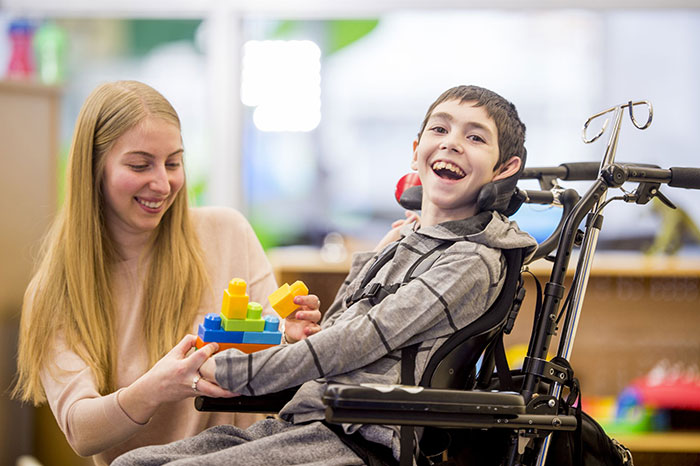
Treatment for cerebral palsy will typically consist of varying levels of physical therapy, occupational therapy, and speech therapy. Specialists have a better idea for planning treatment when they examine and classify the child’s limitations from the beginning.
Identifying a child’s restrictions with the Gross Motor Function Classification System can also provide insight into the type of assistive equipment they may need. This may include tools like wheelchairs or communication devices. Children whose motor skill limitations fall into levels IV and V may be eligible for wheelchair assistance sooner than others.
Using the GMFCS can also help healthcare providers to identify which children may need more intense treatment for their symptoms. Medical procedures like hip muscle release surgery or a selective dorsal rhizotomy (SDR) may be more critical for children at Level V.

The Gross Motor Function Classification System is not designed to track a child’s change or progress with their cerebral palsy symptoms. Instead, medical professionals should utilize the system to:
- Describe a child’s functional status
- Facilitate communication between families and medical providers
- Determine how regularly doctors should monitor the child for potential complications
- Identify which equipment and intervention models will best suit their unique needs
Medical professionals should use the Gross Motor Function Classification System to ensure a child receives sufficient help and intervention.
Is My Child’s Birth Injury the Result of Medical Malpractice?
A child with cerebral palsy will likely face several different physical challenges and disabilities throughout their life. The level of assistance they will require, however, is unique to their own personal symptoms and capabilities.

When birth injury negligence is to blame for causing these injuries, it counts as medical malpractice. Many different medical errors can contribute to a baby’s brain injury that results in cerebral palsy later in life. These mistakes can include missing pregnancy complications, failing to properly monitor fetal heart rates, or needlessly delaying a C-section delivery.
If a family believes medical negligence caused or worsened a child’s cerebral palsy conditions, legal support may be an option. A specialized birth injury attorney can review the medical records and circumstances to assess whether a claim exists.
Families who have experienced the effects of brain damage at birth deserve to know whether better care could’ve prevented them. Our top rated birth injury lawyers will help you find those answers and obtain the necessary funds to secure treatment.
Our team at Miller Weisbrod Olesky will thoroughly investigate the facts, holding responsible parties accountable by pursuing medical malpractice claims.
What is the Statute of Limitations in a Birth Injury Case?

A statute of limitations (SOL) is a law that sets a time limit on how long an injured person has to file a lawsuit after an accident. It is essential to understand that statutes of limitations vary based on the case and the state where you file. For instance, the deadline for birth injury claims is typically different from other claims, such as injury to private property.
Generally, the clock starts ticking on the date the injury occurred. However, there are exceptions to this rule. In some cases, the statute of limitations starts when a person discovers or reasonably should have discovered an injury. When dealing with government agencies, SOLs can become even more complex.
For example, if the party that injured you was:
- A federal employee
- Employed by a military hospital, Veterans Administration facility, or a federally funded medical entity
You may need to file a birth injury claim under the Federal Tort Claims Act (FTCA). In FTCA cases, claimants must go through certain administrative procedures before filing a lawsuit. In some states, you may have less time to give notice if:
- The negligent party was a local or state government hospital.
- The doctors and medical providers are employees of a governmental entity.
If you file your case outside of the statute of limitations, the court will typically dismiss it. This means you will not be eligible to recover compensation for you or your child’s injuries.
Determining when a statute of limitations begins on your case can be tricky. If you are considering pursuing compensation for a birth injury, contact an attorney as soon as possible.
How Can Our Birth Injury Attorneys Help?
Severe cerebral palsy symptoms can be debilitating for a child and negatively impact their quality of life. It takes an expert review of the facts of their birth to determine whether medical professionals made preventable errors.
Our Process
Our team of national cerebral palsy attorneys, nurses and paraprofessionals works to answer these questions and seek compensation. We use our detailed medical negligence case review process to assess your potential birth injury case.
We start by learning more about your pregnancy by gathering records to determine what happened during and after your delivery. This includes a detailed review of the treatment doctors provided or failed to provide before and after birth.
We will call in skilled medical experts who review your records and provide insight into where medical professionals went wrong. If we feel medical negligence caused or worsened your child’s injuries, we meet with you to discuss further.
At no point in our legal intake process will we ask you to pay anything. The medical review of your case and the consultation are free. We only receive payment once you do. The sooner you reach out, the sooner we can investigate your case and gather the evidence to support your claim.
We work on a contingency fee basis, meaning you will not pay any legal fees until we win your case. We do not purse any medical malpractice cases unless we fully believe we can win. Contact us today to schedule your free consultation by calling our toll-free line at (888) 987-0005. You can also reach us by filling out our online request form.
National Birth Injury Law
Our National Birth Injury Attorneys, nurses, and support staff understand that parents of children with birth injuries feel overwhelmed. So, every client has the attention and support of a team of trained, compassionate professionals. But we don’t just offer compassion.
We offer a process to help you discover whether your child’s birth injury, HIE, cerebral palsy or brain injury at birth was caused by medical malpractice.
Call our offices today at (888) 987-0005 for experienced assistance in a free consultation.
Quick Links
Testimonials
- Lyric C. I feel like our voice was heard in a sense of what can possibly go wrong in a delivery and finding us answers. I feel with our settlement, we are now in a comfortable position to provide for our son.
- Lyssa L. They are not just people that say “hey let's get you money and let's go” The law firm was very thorough with us. It was awesome. I don't want to cry, because I think about and it's amazing that they were able to help me and that we were able to help my son and get the story out there.
- Jay C. Throughout the process, one thing was clear to us, the ultimate interest of our child was the utmost concern of Max and his team and as parents navigating a situation like that, that was refreshing to know we had them firmly on our side. I highly recommend them.
Popular Cities
- ★ Dallas Birth Injury
- ★ Houston Birth Injury
- ★ Atlanta Birth Injury
- ★ Chicago Birth Injury
- ★ Philadelphia Birth Injury
Locations
★ Dallas
11551 Forest Central Drive, Ste. 300
Dallas, TX 75243
★ Houston
12929 Gulf Freeway, Ste. 111
Houston, TX 77034