Post Term Pregnancy
What is Post Term Pregnancy?
Post term pregnancy, alternatively called prolonged pregnancy or post maturity, occurs when the pregnancy extends beyond the normal gestation of 37 to 42 weeks from the first day of the last menstrual period (LMP). An estimated 10 percent of all expectant mothers give birth post term.

Birth injury risks increase in a post term pregnancy because the baby may develop macrosomia (larger size than average), the placenta may begin to fail, or the baby may experience meconium aspiration syndrome (the baby breathes a mixture of fecal material and amniotic fluid). These birth complications also put the baby at a risk of hypoxic-ischemic encephalopathy (HIE), which may lead to cerebral palsy.
Medical providers should carefully track the pregnancy and be prepared to induce labor around 40 weeks or even earlier (depending on the condition) rather than allowing the pregnancy to continue further. If your baby has suffered birth injury resulting from post-term pregnancy, you might have grounds to sue for medical malpractice.
Medical negligence may be involved if your labor was not induced on time, the labor was prolonged or arrested, or if the medical provider miscalculated the due date or failed to corroborate it with an ultrasound test. Inaccurate pregnancy dating based on the last menstrual period (LMP) without corroborating it with an ultrasound exam is the most common cause of post term pregnancy.
Significance of Accurate Dating of Pregnancy
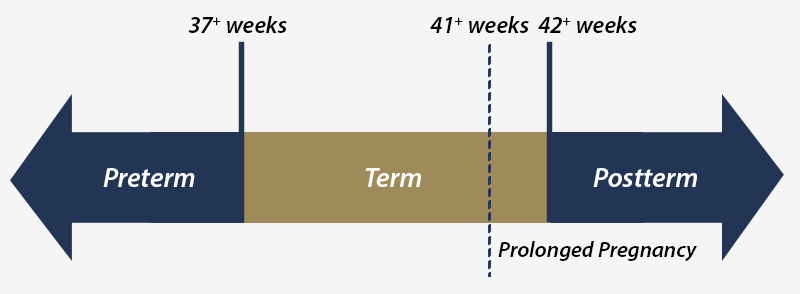
Accurate pregnancy dating is vital to conclusively determine that the pregnancy is post term. The medical provider should ideally determine the accurate gestational age early in the pregnancy. When the expectant mother has a history of regular menstrual periods, a reliable calculation of the date is often possible based on the last menstrual period (LMP) and a pelvic exam.
When the expectant mother has a history of irregular or long menstrual cycles or the uterus size is smaller or larger than expected based on the last menstrual cycle, the medical provider should be more careful while determining the gestational age in order to avoid errors of under- or over-estimation of the due date.
In these cases, it is best to rely on the findings of a fetal ultrasound exam, especially during early pregnancy (up to 20 weeks of gestation) when the estimate of due date will be most accurate. An ultrasound for due date estimation performed in the latter half of the pregnancy will be less reliable.
Diagnosis of Post Term Pregnancy

Correct calculation of due date in a pregnancy requires the medical providers to:
- Measure the uterus size at specific intervals during early pregnancy.
- Document the date when the developing baby’s heartbeat is first heard.
- Document the date when the baby’s movement in the uterus is first felt by the mother.
- Perform an ultrasound exam early in the pregnancy for more reliable estimation.
When a post term pregnancy is determined, the medical provider should perform regular tests to check on the baby’s condition as follows:
- Ultrasound examinations
- Fetal heart rate monitoring
- Measurement of the amniotic fluid index (AFI)
- Measurement of the biophysical profile (BPP) score
Risks of Post term Pregnancy to the Baby
Macrosomia: A post term baby may keep growing after the due date, resulting in macrosomia (larger than average size of the baby for the gestational age). Complications may include prolonged or arrested labor and birth trauma risks of assisted vaginal delivery, and hypoxic-ischemic encephalopathy, which may lead to cerebral palsy.
Meconium Aspiration Syndrome (MAS): Post term babies are at an increased risk of meconium (baby’s fecal material) mixing with the amniotic fluid. Fetal stress may cause the baby to inhale this mixture, which can lead to permanent lung problems or brain damage, which may eventually cause cerebral palsy.
Fetal Dysmaturity: Sometimes the post term baby may stop gain weight beyond the due date because of problems with blood and nutrients supply to the fetus via the placenta. As a result, the baby may suffer from malnourishment. Long-term outcomes may include missed developmental milestones and intellectual disabilities.
Stillbirth: The incidence of stillbirth or neonatal birth in post term pregnancies (4 to 7 deaths per 1,000) is at least twice that of term pregnancies (2 to 3 deaths per 1,000).
Tracking Fetal Health in Post term Pregnancy
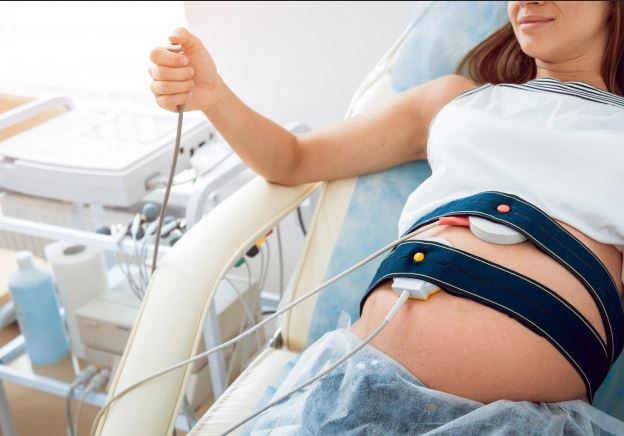
If the pregnancy is likely to extend beyond the due date, the medical provider should order tests to monitor the baby’s health and to evaluate the risks of letting the pregnancy continue further. These tests should begin at 41 weeks of gestation, and performed at least twice weekly. Testing may include fetal heart rate monitoring, biophysical profile test (using ultrasound to monitor the baby’s activity) and tests to measure the amniotic fluid volume.
- Fetal Heart Rate Monitoring: This test involves the use of a Doppler ultrasound device to listen to and record the heart rate patterns of the baby through the mother’s abdomen. Continuous fetal heart rate monitoring during labor and birth may also be performed by fastening the ultrasound probe to the abdomen, while the baby’s heart rate patterns are shown on a computer monitor. An abnormal fetal heart rate may indicate that the baby is experiencing fetal distress due to lack of oxygen or other complications.
- Biophysical Profile (BPP) Test: To assess fetal health, the medical provider will calculate the biophysical profile (BPP) score. It includes fetal heart rate monitoring plus ultrasound measurement of specific fetal parameters as follows:
- Fetal heart rate patterns
- Body movements
- Muscle tone (extension and flexion of a limb or the spine)
- Breathing movements
- Amniotic fluid index
Each of these five components is individually scored. A score of 2 points is assigned if the parameter is normal, while an abnormal parameter is assigned 0 points. The maximum possible BPP score is 10. - Amniotic Fluid Volume Measurement: Measuring the amniotic fluid index (AFI) is important in post-term pregnancy because amniotic fluid low volume may indicate oligohydramnios, which can cause serious birth complications, including umbilical cord prolapse, stillbirth, meconium aspiration, and HIE, which may lead to cerebral palsy. The amniotic fluid index is calculated by separately measuring the depth of the fluid in four quadrants of the uterus and adding the individual measurements together.
Inducing Labor in Post Term Pregnancy
When post term pregnancy is anticipated, the medical provider should evaluate the benefits vs. risks of continuing the pregnancy, assess the condition of the cervix (labor induction will take longer if the cervix is not thinned or dilated), and consider results of the antenatal tests and monitoring to determine the baby’s well-being.
If labor does not spontaneously begin around 41 to 42 weeks of gestation, it is usually time to induce labor. If the cervix is unfavorable, application of medications to the cervix or vagina should be considered to dilate and soften the cervix. Mechanical techniques, such as the insertion of a Foley bulb (a catheter-like device) through the cervix may also be used to accomplish cervical change.
In most such cases, including mothers with a favorable cervix, inducing labor will also require medications, such as oxytocin administered intravenously to stimulate uterine contractions and dilate the cervix. If labor induction fails to achieve full cervical effacement and dilation, or there is a risk of birth complications, the medical provider should be prepared to quickly perform a cesarean section.
Is Your Child’s Birth Injury the Result of Medical Malpractice?
Parents whose children suffer from post term pregnancy related birth trauma or birth complications want and deserve answers as to the cause of their child’s birth injury and whether mistakes by the doctors and nurses contributed to the injury.
- Were there signs of birth injury or birth complications during the pregnancy, labor, and delivery process, or presence of risk factors, which were either not recognized or properly treated?
- During the labor and delivery, were there clear indications that the baby was suffering from fetal distress, but appropriate actions were not taken by the obstetrician or nurses?
- Was there a delay in diagnosis of a post term pregnancy that led to later complications, including brain injury?
- Did the medical team fail to order a series of tests to diagnose this birth complication in a timely manner?
- Was the decision to perform a cesarean delivery delayed leading to birth trauma during vaginal delivery or labor?
- Did the neonatal resuscitation team fail to quickly begin important breathing support?
- Should brain cooling (also called “hypothermia therapy”) have been provided to your baby, but the doctors and nurses failed to perform the appropriate tests or ignored the results of the tests?
Our national birth injury attorneys have extensive experience in this and all areas of birth injury medical malpractice. The lawyers and nurses at Miller Weisbrod Olesky will help you determine if mistakes of the medical providers caused a birth injury to your child, including Hypoxic-Ischemic Encephalopathy (HIE) or cerebral palsy.
Our award-winning birth injury attorneys represent families all over the United States in their time of need after a wrongful birth. We use our skills and expertise to obtain for you and your child a medical malpractice settlement that will help provide specialized medical therapy in order to maximize the quality of life and independence of your child throughout their life.
Sometimes families are reluctant to contact a medical malpractice lawyer. It’s also not uncommon for parents to feel overwhelmed by the responsibilities they encounter in caring for their injured child and worried that they will not be able to help out in a lawsuit involving their child’s birth injury. Our birth injury attorneys and nursing staff will address these hesitations and concerns, so you can focus on your child and maximizing their care.
Registered Nurses and Nurse-Attorneys Are a Vital Part of Our Birth Injury Team…and Yours

Most birth injury law firms will employ one or two nurses to assist the review of cases and medical research. But Miller Weisbrod Olesky offers an unmatched number of nurses and nurse-attorney employees support to both the birth injury attorneys and our clients.
Our team of registered nursing staff and nurse-attorneys bring a deep level of medical and personal insight to every client’s case. Our nursing team includes both an experienced labor and delivery nurse as well as an ICU nurse. Working closely with the rest of the team, they investigate the reasons behind a birth injury and how medical professionals breached their standard of care.
Why Should You Talk with the Highly Capable Attorneys at Miller Weisbrod Olesky?

The only way to find out if you have a birth injury case is to talk to a lawyer experienced in birth injury lawsuits. It’s not uncommon that a birth related complication results in a preventable birth injury, including cerebral palsy, but it takes a detailed expert review by a birth injury attorney of the medical records from your child’s birth to determine if the birth injury was the result of medical malpractice.
At Miller Weisbrod Olesky, a team of committed lawyers, nurses and paralegals uses our detailed medical negligence case review process to assess your child’s potential birth injury case. We start by learning more about you and your child and the status of meeting/missing developmental milestones. Then we gather medical records to determine what happened before, during pregnancy. We call in documented and proven medical experts who review your records and let us know if they think medical errors could have caused your child’s injuries.
If we feel medical negligence caused or contributed to wrongful birth in your case, we meet with you to discuss how you can receive compensation from the medical professionals who made the errors. Our birth injury attorneys have recovered millions of dollars in settlements for families of children that have suffered a birth injury.
At no point in our legal intake process will we ask you to pay anything. The medical review of your case and the consultation are free. We only receive payment when you do no matter how long or tough your case is.
Contact Our Birth Injury Lawyers
National Birth Injury Law
Our National Birth Injury Attorneys, nurses, and support staff understand that parents of children with birth injuries feel overwhelmed. So, every client has the attention and support of a team of trained, compassionate professionals. But we don’t just offer compassion.
We offer a process to help you discover whether your child’s birth injury, HIE, cerebral palsy or brain injury at birth was caused by medical malpractice.
Call our offices today at (888) 987-0005 for experienced assistance in a free consultation.
Quick Links
Testimonials
- Lyric C. I feel like our voice was heard in a sense of what can possibly go wrong in a delivery and finding us answers. I feel with our settlement, we are now in a comfortable position to provide for our son.
- Lyssa L. They are not just people that say “hey let's get you money and let's go” The law firm was very thorough with us. It was awesome. I don't want to cry, because I think about and it's amazing that they were able to help me and that we were able to help my son and get the story out there.
- Jay C. Throughout the process, one thing was clear to us, the ultimate interest of our child was the utmost concern of Max and his team and as parents navigating a situation like that, that was refreshing to know we had them firmly on our side. I highly recommend them.
Popular Cities
- ★ Dallas Birth Injury
- ★ Houston Birth Injury
- ★ Atlanta Birth Injury
- ★ Chicago Birth Injury
- ★ Philadelphia Birth Injury
Locations
★ Dallas
11551 Forest Central Drive, Ste. 300
Dallas, TX 75243
★ Houston
12929 Gulf Freeway, Ste. 111
Houston, TX 77034